
The Future of Saving: Lessons from Decades of Defined Contribution Plan Design

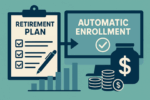
Illustration depicting a retirement plan with a checklist and pen, connected by an arrow to a computer screen labeled "Automatic Enrollment" with a checkmark. A money bag and stacks of coins symbolize financial planning.

Automatic enrollment has transformed U.S. retirement savings, but its long-run impact is more nuanced than early studies suggest. Professor Jonathan Reuter’s investigation shows that while behavioral nudges boost participation, they also anchor employees to defaults, lead to unintended leakage, and can increase household debt. The challenge to retirement plan policymakers is to build plans that boost participation and account for diverse needs.Read More

Financial and Health Literacy Falls As Adults Age, While the Gender Gap Remains

Icons representing finance, health, and well-being over water ripples, symbolizing interconnected aspects of life.

A decade-long study of more than 1,000 older adults shows that financial and health literacy decline steadily with age, dropping about one percentage point each year. These findings highlight growing risks in money management and medical decision-making, and point to the need for early, targeted interventions to support financial well-being—particularly for women.Read More

Beyond IQ: How Grit and Conscientiousness Shape Your Retirement Future

An illustration of an open toolbox labeled "Financial Success" with tools labeled "Conscientiousness," "Self-Control," and "Planning" nearby, symbolizing key traits for financial success.

In their research, Gianpaolo Parise and Kim Peijnenburg demonstrate that traits such as conscientiousness, grit, locus of control, and emotional stability significantly shape individuals’ saving, investing, and retirement planning behaviors. Their findings underscore an important insight: personality traits, alongside income and financial literacy, are critical determinants of long-term wealth accumulation and retirement preparedness.Read More

Do People Save Enough For Retirement? New Evidence from Household Finance

An illustration of an older couple in a kitchen. One person is placing groceries into a fridge, while the other is putting money into a pink piggy bank.

When it comes to longevity, the U.S. is falling far behind its peers. Through his analysis, Steve Utkus reveals a sobering reality – Americans not only live shorter lives than citizens of other wealthy nations, but they also spend fewer years in good health. His findings highlight an urgent challenge: Americans get sicker faster and die earlier, despite living in one of the world’s richest nations.Read More

High Time to Prioritize Healthspan

Illustration of a diverse group of people jogging in a side view. They wear casual clothing and are depicted in motion, suggesting community exercise or a group activity.

When it comes to longevity, the U.S. is falling far behind its peers. Through his analysis, Steve Utkus reveals a sobering reality – Americans not only live shorter lives than citizens of other wealthy nations, but they also spend fewer years in good health. His findings highlight an urgent challenge: Americans get sicker faster and die earlier, despite living in one of the world’s richest nations.Read More

The Hidden Cost of Staffing Shortages in Nursing Homes: Too Few Nurses, More Drugs

A hospital corridor with a glowing "Nurse Call" light fixture on the wall, indicating a request for nursing assistance.

When staffing levels drop in U.S. nursing homes, something troubling rises: the use of powerful antipsychotic drugs to sedate vulnerable residents. In a new study, Ken Moon, Jong Myeong Lim, and Minje Park reveal a disturbing causal link—too few nurses lead to more residents being medicated, not for treatment, but to manage behavior. Their findings suggest that stronger staffing rules could significantly reduce serious ethical concerns.Read More

What the Pandemic Can Teach Us About Life Insurance Demand

A person holding documents labeled "Life Insurance" and "Vaccinated" with a large shield in the background, representing protection and security.

COVID-19 surprised everyone by confronting them with both health and financial shocks, forcing consumers to reassess their own vulnerability and, potentially, their need for life insurance.

“The COVID-19 pandemic was catalyst for an unprecedented convergence of health and financial risks, forcing consumers to reexamine their vulnerability and, potentially, their need for life insurance. A new study investigates how these shocks influenced consumer demand for life insurance. Report by Abigail Hurwitz, Olivia S. Mitchell at the University of Pennsylvania, and Orly Sade of the Hebrew University of Jerusalem. Via RetireSecure blog.Read More

Private Equity and Crypto and Bears, Oh My!

An illustration of a busy financial trading room with bears, cryptocurrency symbols, and screens displaying financial data. Several people are working with stacks of coins and charts around them. The text reads: "Private Equity and Crypto and Bears, Oh My!"

Alternative assets, such as private equity and crypto currencies, are emerging as investments that people can hold in their retirement accounts. Yet retirement assets need to produce returns that can sustain an expected lifestyle throughout retirement. Before adding these new alternatives to retirement portfolios, investors must learn how and why they differ from traditional assets like stocks and bonds and decide if they can bear the risks. Via RetireSecure blog.Read More