
Abigail Hurwitz is a Senior Lecturer (Assistant Professor) at the department of Environmental Economics and Management at the Hebrew University of Jerusalem. Olivia S. Mitchell is the International Foundation of Employee Benefit Plans Professor of Business Economics/Policy and Insurance/Risk Management at The Wharton School, University of Pennsylvania. Orly Sade is the Dean of the Hebrew University Business School, The Albertson-Waltuch Chair in Business Administration and Professor of Finance, Hebrew University Business School. Hebrew University, Jerusalem, Israel.
When COVID-19 first spread across the globe in early 2020, it surprised everyone by confronting them with both health and financial shocks. Lockdowns, overwhelmed hospitals and nursing homes, and daily headlines about elevated death rates due to the disease forced consumers to reassess their own vulnerability and, potentially, their need for life insurance.
Our new study on selection in life insurance markets examines behavior during this unanticipated health crisis, seeking to address two questions:
- Did higher-risk individuals turn to life insurance as mortality fears increased?
- Were life insurance policyholders more likely to adopt protective behaviors such as getting vaccinated, once they were covered?
Drawing on a three-wave internet survey of 2,068 U.S. residents, along with administrative data on life insurance cancellations in Israel, we uncovered no evidence of adverse selection. Instead, advantageous selection and “protective behavior” dominated pandemic dynamics.
The Results
Interestingly, our research confirmed that older and less-healthy Americans were no more likely to buy new life insurance during COVID-19 than their lower-risk peers. Similarly, vulnerable Israelis did not hold onto or cancel their existing policies disproportionately. We also showed that more risk averse individuals were about two percentage points more likely to purchase life insurance coverage during the pandemic shock.
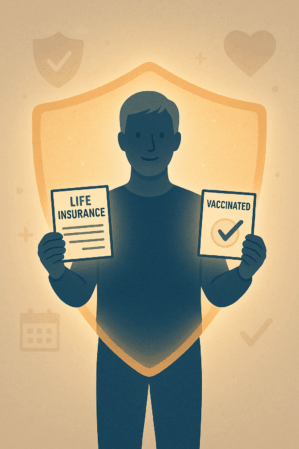
And finally, we learned that people holding life insurance policies were significantly more likely to get vaccinated, 32% versus 26% of the uninsured — even after adjusting for eligibility rules and risk preferences. This implies that persons holding life insurance also took active steps to mitigate the new risks associated with COVID-19.
Additional Detail
Older and less-healthy U.S. respondents had the same probability of buying new life insurance purchases as their younger and healthier counterparts. In Israel, the ratio of cancellations among high-risk versus low-risk Israelis remained flat from 2019 through 2021.
Also, in the US survey, a one-unit increase in financial risk aversion raised the likelihood of buying new life insurance by about two percentage points, consistent with the view that risk-averse consumers demanded more protection.
The fact that insured individuals were measurably more likely to get vaccinated indicates that people holding life insurance not only sought coverage but also engaged in subsequent actions to reduce mortality risk. This is a novel insight that we term protective behavior.
Why This Matters
In the past, insurance research posited that people in worse health will seek more insurance than those in better health, particularly when insurers cannot easily detect peoples’ health status. This phenomenon is known in the literature as ‘adverse selection.’ Clearly this can be a concern to insurance companies, since they could face unexpected claim surges when a crisis strikes.
Yet during COVID-19, we found the opposite. In both the US and in Israel, the most vulnerable neither bought nor held onto their life policies disproportionately. This evidence therefore rules out adverse selection for the life insurance industry, during the pandemic.
Consequently, insurers may not face a wave of high-risk buyers during health crises, allowing for them to predict more stable reserves and smoother underwriting practices.
Views of our Guest Bloggers are theirs alone, and not of the Pension Research Council, the Wharton School, or the University of Pennsylvania.